
Research · Peer-Reviewed Science
Two Peer-Reviewed Silvervine Studies.
Here's What They Actually Found.
Most silvervine claims come with zero citations. We pulled the two real, peer-reviewed studies — including what they didn't find. Here's the honest read.
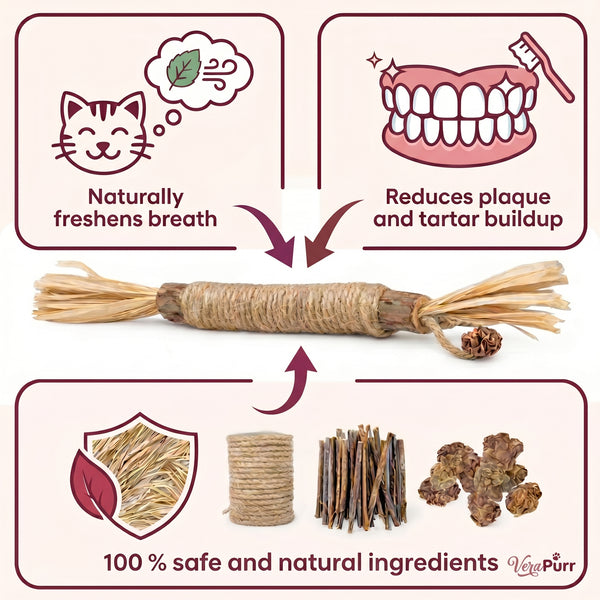
VeraPurr — 4 natural ingredients, nothing else.
The internet is full of silvervine claims, and most of them are coming from product pages with no citations attached. We're not doing that. This article covers what two peer-reviewed, published studies actually demonstrated — and where the science genuinely stops. Anything we can't back up, we won't claim.
Study 1: Bol et al. (2017) — BMC Veterinary Research
The big question this one set out to answer: do cats actually respond more to silvervine than catnip? They tested 100 domestic cats. Here's what the numbers came back with.
79% of cats responded to silvervine vs 68% for catnip. Approximately 75% of catnip non-responders responded to silvervine. Responses were statistically more intense (P = 0.02) — meaning if your cat shrugs at catnip, the odds they engage with silvervine are still high.
Study 2: Uenoyama & Miyazaki (2021) — Science Advances
Four years later, a different team asked the harder question: why does silvervine work? They were measuring actual neurochemistry — not just whether cats rolled around, but what was happening in the blood while they did.
Silvervine exposure measurably elevated β-endorphin levels in cats' blood. The primary active compound is nepetalactol — distinct from catnip's nepetalactone but activating the same μ-opioid receptors. The response is not learned behaviour. In plain English: this is hardwired biology, not a habit your cat picked up.
Dental Health — Honestly
Here's the part we're not going to dodge: neither study directly measured plaque reduction. We are very specifically not claiming they did. The dental benefit argument rests on an established and uncontroversial veterinary principle — sustained mechanical chewing on fibrous material disrupts plaque before it has time to mineralise into tartar.
So the chain is this: the studies prove silvervine reliably triggers sustained chewing. Veterinary dentistry already accepts that sustained chewing on fibrous material disrupts plaque. The dental benefit is biology, not magic — and not something we'd ask you to take on faith.
"The chew phase is neurological. In the wild, shredding prey maintained dental health. Indoor cats have the same drive — with nowhere for it to go."
— From the biology of feline predatory behaviour