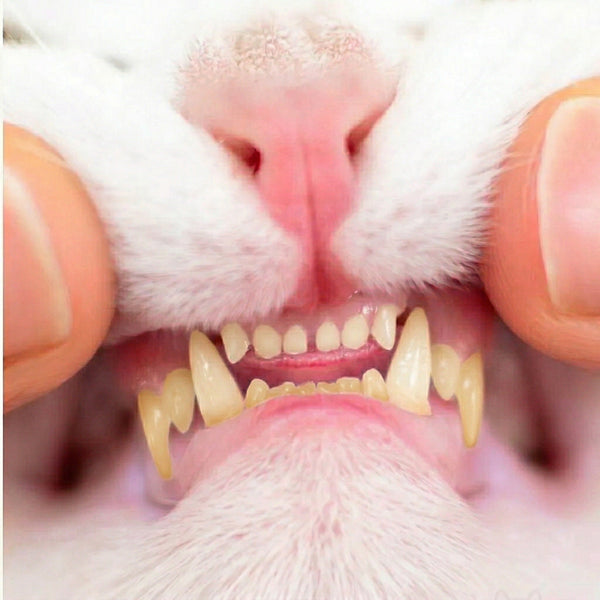
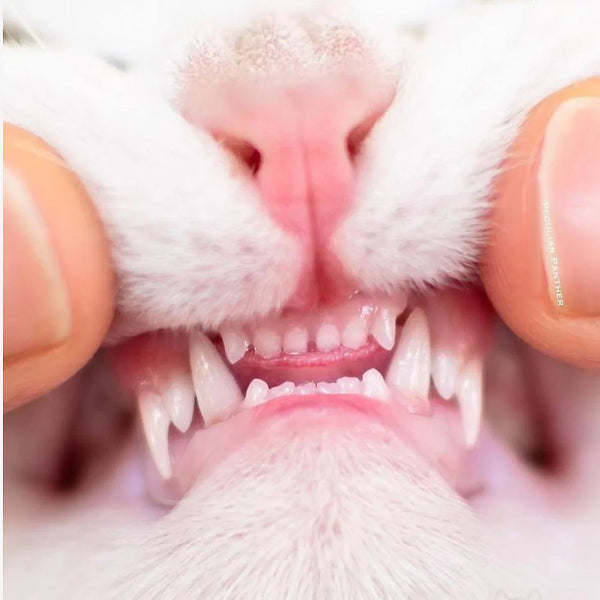
 Before
After
Before
After
Cat dental disease is the most underdiagnosed condition in pets — and it's not because vets aren't talking about it. It's because the myths telling you everything's fine are everywhere, and they're sticky. Most cat parents only learn the truth when the vet hands them a four-figure estimate. Let's fix that today.
❌ Myth 1
"Dry food cleans my cat's teeth."
✓ The Truth
This one is the pet industry's most successful piece of marketing. Feline vet Dr. Jean Hofve has examined over 13,000 cat mouths and put it plainly — kibble shatters on contact and never reaches the gumline. The Veterinary Oral Health Council has never approved a single standard dry kibble for plaque or tartar control. Crunchy ≠ scrubbing. Always has been.
❌ Myth 2
"My cat's teeth are fine — she's still eating normally."
✓ The Truth
Cats are evolutionary masters at hiding pain — it's literally a survival trait. Research confirms cats will keep eating normally with severe periodontal disease, missing teeth, even active infection. By the time your cat actually drops a piece of kibble, this has often been brewing for months. The real early warning isn't appetite — it's bad breath.
❌ Myth 3
"She's only 2 — dental problems are for older cats."
✓ The Truth
Dental disease isn't an age problem — it's a plaque problem, and plaque doesn't care how old your cat is. The American Veterinary Dental College reports up to 85% of cats over age three already show signs of periodontal disease. Plaque hardens into tartar in 24–72 hours. Once it's tartar, the only thing taking it off is a vet, a scaler, and a cat under anaesthesia.
❌ Myth 4
"Dental treats are basically the same as brushing."
✓ The Truth
Most "dental" treats are crunched and swallowed in 2–5 seconds — roughly the same gumline contact as a grape. And it gets worse: a veterinarian publicly confirmed that one popular brand was actually increasing tartar buildup in the cats studied. The only thing comparable to brushing is something your cat will voluntarily chew for minutes, not seconds.
❌ Myth 5
"Water additives and dental rinses work well for cats."
✓ The Truth
A board-certified veterinary dentist compared water additives to dropping a single drop of Listerine into a full glass of water. The math doesn't work. And here's the part nobody mentions: many cats taste it and drink less water — a real problem for a species already prone to kidney disease. You can actually make things worse trying to make them better.
So what actually works? (Spoiler: it isn't what you've been buying.)
Every one of these myths has the same thing in common — they make you feel like you're doing something, while the actual problem (no sustained mechanical chewing) stays unsolved. The toothbrush is technically the gold standard, but 96% of cat parents can't make it happen, and the 4% who can are basically doing dentistry on a cat. Silvervine sticks close the gap with the one thing nothing else delivers — a cat who voluntarily chews for 15 to 30 minutes. No myth. No marketing. Just a cat cleaning their own teeth, every day, because they want to.
No myths. Just a cat cleaning their own teeth.
4 natural ingredients. 90%+ response. From $29.99. Money-back guarantee.
Shop VeraPurr →